Searching for investing RobTheCoins can lead to a basic question: is RobTheCoins something you invest in, or is it a source of information about investing?
That distinction matters. RobTheCoins is better approached as an informational resource covering investing, cryptocurrency, and related financial topics. Readers should not assume the name itself represents a cryptocurrency, investment fund, brokerage, or trading product without reliable evidence confirming it.
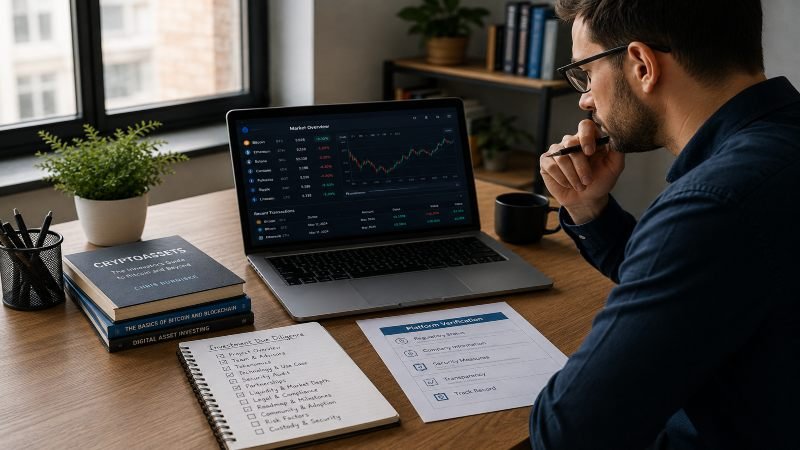
For someone researching investing through RobTheCoins, the useful starting point is not finding the next asset to buy. It is learning how to judge an investment, recognize risk, verify financial claims, and make decisions based on evidence rather than excitement.
What Does Investing RobTheCoins Mean?
The phrase can be confusing because it sounds like the name of an investment product. In an informational context, however, it refers more naturally to investment-related content associated with RobTheCoins.
That content may introduce readers to subjects such as stocks, cryptocurrency, market research, portfolio risk, and investment strategies.
There is an important difference between learning about an investment and investing in it. An article can explain Bitcoin, stocks, exchange-traded funds (ETFs), or other assets, but reading that information does not make the publisher a broker or investment provider.
Readers should always identify the actual asset or financial service involved before committing money.
Start With the Investment, Not the Hype
A surprising number of poor financial decisions begin with a simple problem: the investor does not fully understand what they are buying.
Before looking at potential returns, establish what the investment actually is.
For a stock, that means understanding the company behind it and how the business makes money. With an ETF, you should know what the fund holds and what it is designed to track. For cryptocurrency, the questions may include what the project does, how its network works, and why its token has a role in that system.
A few basic questions can expose gaps in your research:
- What exactly am I buying?
- Where could a return come from?
- What are the main reasons its value could fall?
- Can I sell the investment easily if I need to?
- Are important claims supported by reliable information?
If those answers remain unclear, there is little reason to rush.
Different Investments Carry Different Risks
There is no single type of investment that suits every person. Assets behave differently, and the risks attached to them can vary considerably.
| Investment | Potential source of return | Important risks |
|---|---|---|
| Stocks | Price growth and dividends | Business and market losses |
| Bonds | Interest and repayment of principal | Credit and interest-rate risk |
| ETFs | Performance of underlying holdings | Market and fund-specific risk |
| Real estate | Rental income and property appreciation | Property costs and limited liquidity |
| Cryptocurrency | Increase in market value | Volatility, security and project risk |
This is why comparing investments only by their recent returns can be misleading. A high potential return usually does not come without meaningful uncertainty.
Your financial goals also matter. Money needed within a year has a different purpose from money being invested for a goal decades away.
How to Use RobTheCoins for Investment Research
Investment articles can help readers understand unfamiliar terminology, explore an asset class, or identify questions worth researching further.
That is a sensible role for RobTheCoins.
The next step is verification. If an article discusses a public company, for example, important financial details can be checked against the company’s official disclosures and regulatory filings. Information about an ETF should be compared with documentation from the fund provider.
Crypto research requires similar discipline. A project’s own website may explain what its developers claim to be building, but those claims should not automatically be treated as independent evidence of value or legitimacy.
Useful research often involves comparing several types of information rather than relying on a single page.
Crypto Investing Needs a Closer Look
Cryptocurrency deserves particular attention because buying a digital asset can expose an investor to risks beyond ordinary price movements.
Start with the project’s purpose. What is the cryptocurrency supposed to do? Does the token have an identifiable use, or does most of the discussion revolve around its price?
Then look at supply. Understanding how many tokens exist, how new tokens enter circulation, and who controls large holdings can provide useful context.
Security matters as well. Crypto investors may have to consider exchanges, private keys, wallets, scams, phishing attempts, and irreversible transactions. Even a legitimate digital asset can be lost if it is stored or transferred carelessly.
Liquidity is another consideration. A quoted market price does not necessarily mean you can sell a large position at that exact price, particularly with smaller or thinly traded tokens.
None of these checks can eliminate risk. They can help reveal risks that promotional material may leave out.
Be Careful With Investment Claims
Financial content becomes less useful when confidence replaces evidence.
Statements such as “guaranteed returns,” “risk-free profits,” or claims that an asset can only increase in value deserve serious scrutiny. Legitimate investments can lose value, sometimes significantly.
Price predictions should also be treated as forecasts rather than facts. Nobody knows with certainty where a stock, cryptocurrency, or market will trade in the future.
The same caution applies to social media. A large following does not make someone financially qualified, and popularity does not establish that an investment is sound.
Check who is making the claim, what evidence supports it, and whether that person or organization has a financial interest in your decision.
Risk Management Is Part of Investing
Research helps you decide whether an investment deserves consideration. Risk management helps determine how much damage you could face if your decision turns out to be wrong.
Diversification is one familiar way to manage that problem. Holding different investments can reduce dependence on the performance of a single company, sector, cryptocurrency, or asset type.
It does not guarantee a profit or protect a portfolio from every market decline.
Position size is just as important. A speculative asset should not automatically receive the same allocation as a diversified holding simply because its potential return looks attractive.
Investors also need to consider their time horizon. Someone saving for a near-term expense may have far less ability to tolerate a major decline than someone investing toward a goal many years away.
Investing and Trading Are Not the Same
These terms are often used interchangeably, but they can describe very different behavior.
Investing generally focuses on holding assets over a longer period. Decisions may be based on company fundamentals, diversification, income, long-term growth, or another defined financial objective.
Trading usually involves trying to benefit from shorter-term price movements. It can require more frequent decisions and closer attention to market conditions.
Neither approach makes profits certain.
The important point is to know which approach you are taking. Buying something because you believe in its long-term value and then panic-selling after a short-term decline suggests the original plan was not clearly defined.
Common Mistakes New Investors Make
Beginners do not need to know everything before they start learning about markets. They do, however, benefit from recognizing a few recurring mistakes.
Buying simply because an asset has recently risen is one of them. A strong past performance can attract attention, but it says little about what will happen next.
Another mistake is concentrating too much money in one investment. Even detailed research can be wrong, and unexpected events can change an otherwise reasonable investment case.
Other problems come from borrowing money to speculate, following anonymous tips, ignoring fees, or investing cash needed for essential expenses.
A simple written plan can provide some discipline. Record why you are considering an investment, the major risks you see, how long you expect to hold it, and what would cause you to reconsider the decision.
Is RobTheCoins Useful for Beginners?
For a beginner, RobTheCoins can be used as one starting point for understanding investing and cryptocurrency topics.
The goal should be education rather than looking for instructions on exactly what to buy.
Learning concepts such as diversification, volatility, risk tolerance, asset allocation, liquidity, and investment time horizons makes it easier to evaluate financial information from many sources.
As your knowledge grows, primary sources become increasingly important. Company filings, official fund documents, regulatory resources, and verified project information can provide details that summaries cannot always capture.
Final Thoughts
The most useful way to approach investing RobTheCoins is as a research and education topic rather than assuming RobTheCoins itself is an investment.
Investment content can introduce an idea and help explain how it works. The decision to risk money requires another level of research.
Know what you are buying. Check important claims independently. Consider what could go wrong as carefully as what could go right. Whether the subject is stocks, ETFs, cryptocurrency, or another asset, those habits are more useful than chasing predictions or short-term market excitement.